Wednesday, 25 April 2012
The Go-Away Bird
The Go-Away Bird - Muriel Spark
This collection of short stories shows Spark's range. The go-away bird of the title is 'the grey-crested lourie', a bird who's call seems to be "go'way, go'way". There are eleven stories in this collection, originally published in a variety of places and they are varied but with some recurring themes.
I really enjoyed this book - it is full of energy and oddness. I have decided to post a little piece on each story rather than try to come up with a unified theory of everything.
Labels:
Books,
Books 2012,
Muriel Spark,
Short Stories
Monday, 23 April 2012
Robinson
Robinson - Muriel Spark
"I recall that Robinson had advised more than once 'Stick to facts.'"
On a small island called Robinson a group of survivors from a plane crash are rescued by the island's owner Robinson and his adopted son Miguel. The survivors are January Marlow, the narrator; Jimmie Waterford, a relative of Robinson who was, strangely, on his way to the island; and Tom Wells, publisher of "Your Future"* a hokey spiritualist type magazine and purveyor of lucky charms and other 'services'). There is no way to contact the outside world and they must simply wait for the arrival of a boat which will come to collect pomegranates in a few months. There is a map of the island at the beginning and it looks like the chalk outline of the victim at a murder scene. (see below) Who, or what, is the victim? Perhaps it is the novel itself. And who is guilty, and what are they guilty of?
Labels:
Books,
Books 2012,
Muriel Spark
Friday, 20 April 2012
New P.I.L. track - Lollipop Opera
Lollipop Opera
Here's a track from the new P.I.L. album, This is P.I.L. to be released May 28th. Good to hear John still in good voice.
Labels:
Irish in England,
Music,
P.I.L.
The Mulching of America
The Mulching of America - Harry Crews
The recent death of Harry Crews inspired me to pick this out from my TBR pile. I was intending to read it soon anyway. It's not that often that I've seen his books on charity shop bookshelves so when I did I was looking forward to resuming reading his work. I had read a good few of his books in the nineties, and loved them. They were pretty unique, as if written by the offspring of a union between Flannery O'Connor and Nathanael West.
Although The Mulching of America is not one of Crews best it was still an enjoyable read. The main character Hickum Looney is forever destined to compete for the position of being Soaps for Life's second best salesman. The Boss is always the best, and always will be. That is, until Hickum meets Ida Mae and not alone does she buy but she takes him to her friends helps him to break the all time sales record for one day. The most powerful force in this sales drive is the fear of death. "She (Ida Mae) breathed on him and he smelled the old friendly and final odor of death. It had never bothered him. Actually he had come to enjoy it. Everybody's breath to one degree or another smelled of death to Hickum Looney. Most people couldn't smell it because they were afraid of the truth." Selling to people who are closer to death is therefore easier and "she had taken him through enclaves of men and women who were sick and dying from the same incurable disease: age.". What Ida Mae seems to buy is the idea that he has somehow helped her push death back, and this is what she sells "from one elderly village to the next elderly village."
Labels:
Books,
Books 2012,
Harry Crews
Thursday, 12 April 2012
Little Dieter Wants to Fly
Little Dieter Wants to Fly - Werner Herzog
Dieter has a story. As a boy he watched fighter planes swoop over his small hometown in Germany. Seeing the pilot in a cockpit almost close enough to touch exploding into and out of his vision was an epiphany for him. He would fly.
Post war Germany is brought to life in a quick sketch - footage of sausages in a window being stared at by passers by accompanies Dieter's memory of seeing a sausage for the first time three years after the war ended - but nobody could afford it. It would have been better than boiled wallpaper though.
Dieter has a story. As a boy he watched fighter planes swoop over his small hometown in Germany. Seeing the pilot in a cockpit almost close enough to touch exploding into and out of his vision was an epiphany for him. He would fly.
Post war Germany is brought to life in a quick sketch - footage of sausages in a window being stared at by passers by accompanies Dieter's memory of seeing a sausage for the first time three years after the war ended - but nobody could afford it. It would have been better than boiled wallpaper though.
Labels:
Film,
Werner Herzog
Monday, 9 April 2012
The Guermantes Way (Second Post)
The Guermantes Way (Second Post) - Marcel Proust
Well, so much for promises. (see first post) As Proust says, life is always a little different to our expectations of it. I fully intended posting a second post hot on the heels of my previous one but my ability to type (and read) is being severely compromised by an episode of back pain. On top of discomfort I am also in a fairly constant state of slight wooziness due to the painkillers. (This is of course to excuse in advance the fact that this post may make even less sense than usual.)
Labels:
1001 Books,
Books,
Books 2012,
Marcel Proust
Monday, 2 April 2012
Travels in the Scriptorium
Travels in the Scriptorium - Paul Auster
It's been a while since I've read anything by Paul Auster (at least 10 years) but I won't leave it as long until the next time. Mazy games, precision and absolute imprecision, stories that may or may not be stories, it's familiar Auster territory to me. Mr Blank, at times a stand in for Kafka's K(The Trial), at times Flann O'Brien's Mr Trellis(At Swim Two Birds), is in a room. He awakens without any memories of how he got there and cameras and microphones are recording his every twitch and fart. (sorry if that's a little rich(ard)) In fact the camera shoots one frame per second so we can visualize Mr Blank moving like a stop motion animation of a man, or like in an early silent film, perhaps starring Auster's hero Beckett's hero Buster Keaton.
Labels:
Books,
Books 2012,
Paul Auster
Sunday, 1 April 2012
The Springs of Affection
![]() |
| Maeve Brennan / Holly Golightly? |
The Springs of Affection - Maeve Brennan
This selection from the short stories of Maeve Brennan contains three suites of stories, each suite having the same characters. They almost work as episodic novellas, particularly the final suite of stories about the Bagots. I have already posted on the first two stories The Morning after the Big Fire and The Old Man and the Sea.
Most of the stories take place on a road in Ranelagh identical to the one where Brennan spent her formative years. The houses are grey and the geography described within almost all the stories is very limited. Indeed the colour gray and the phrase dead end could be considered the watchwords of this collection.
Labels:
Books,
Books 2012,
IrishLit,
Maeve Brennan,
Short Stories
Tuesday, 20 March 2012
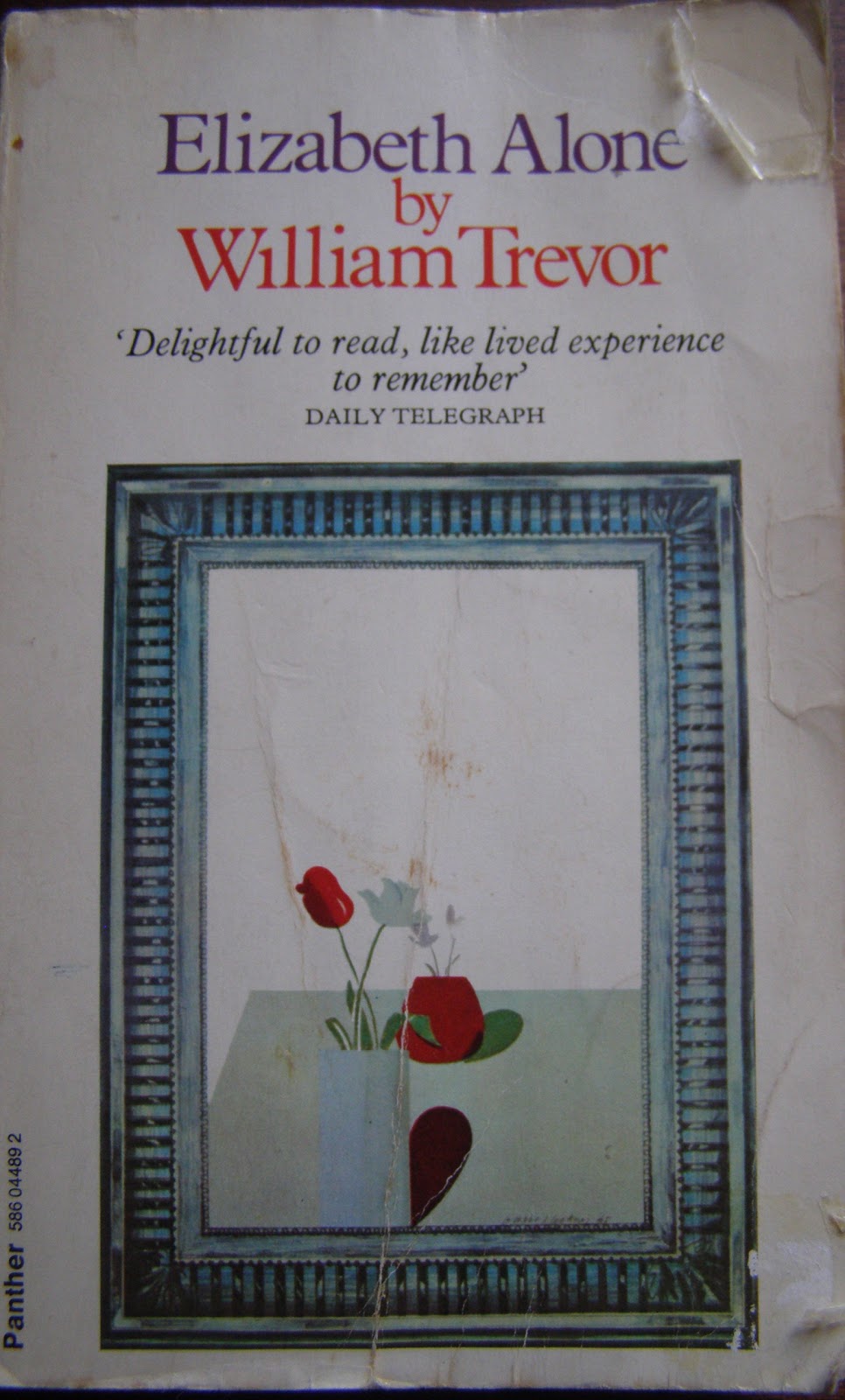
Elizabeth Alone
Elizabeth Alone - William Trevor
William Trevor's Elizabeth Alone is not a novel that I had heard of. In fact, there are a number of Trevor novels I haven't heard of. Although many people have praised him to me, and I've read positive press, there are only a few titles that I've retained. These include the two I've read Two Lives and Felicia's Journey, both of which I enjoyed immensely. And his great short story The Ballroom of Romance. I don't know why this is. Maybe I just wasn't paying attention.
Labels:
Books,
Books 2012,
IrishLit,
William Trevor
Sunday, 18 March 2012
Something Special
Something Special - Iris Murdoch.
I'm reading this in part to partake in Irish Short Story Week and also to finally post something on Iris Murdoch who is one of my favourite writers. I went through a 'phase' of reading everything by her I could get my hands on. This short story is quite different from her novels, both in setting and in style.
This is, or so the fly leaf tells me, the only short story that Iris Murdoch wrote for publication in her life. It is also, I feel, the most distinctly Irish of her writings, feeling very much like an offshoot of Joyce's Dubliners.
The connection is made quietly explicit by the reference to Araby in this quote. "'It's the women's magazines,' said her uncle, 'and the little novels she's forever reading that are putting ideas in her head until she won't marry except it's the Sheik of Araby.'" Joyce's story Araby examines the difference between romantic expectation and reality and Something Special treads similar ground.
Labels:
Books,
Books 2012,
Iris Murdoch,
IrishLit,
Short Stories
Friday, 16 March 2012
The Guermantes Way (First Post)
The Guermantes Way
I am now half way through Proust's masterpiece, and, I feel, gathering some impetus. In The Guermantes Way, Proust focuses even more strongly on society as Marcel makes his first forays into the Fauborg Saint Germain - the aristocratic center of Parisian society. The Guermantes whose family gave their name to one of the paths Marcel and his family used to walk on in the halcyon childhood days at Combray are at the centre of the wittiest Parisien drawing rooms. The Guermantes wit is famous, at least in the mind of our aspiring social climber cum narrator. We are told that this impression has been altered by time, however. All the time we are being told that we are moving towards the maturity of Marcel, a time when he is less credulous, less fatuous in his obsessions, when he becomes the author of this work.
The book explores many social issues as well as the evolution of the artist. As we move through society our viewpoint is often turned towards instances of anti-semitism, homophobia, the life of servants and the emptiness at the heart of 'society'.
Early on we are given a view of the 'young master' from the family's servant Francoise. This gives us a different angle on the narrator than he paints himself, and ties in with further thoughts on the position of servants amoung his circle. "Ah, Combray, when shall I look on thee again, poor land! When shall I pass the blessed day among thy hawthorns, under our own poor lily oaks, hearing the grasshopper sing, and the Vivonne making a little noise like someone whispering, instead of the wretched bell from the young master, who can never stay still for half an hour on end without having me run the length of that wicked corridor. And even then he makes out I don't come quick enough; you'd need to hear the bell ring before he has pulled it, and if you're a minute late, away he flies into the most towering rage." The fact that Francoise starts out reminiscing about Combray and the hawthorns that Marcel values so highly serves to emphasize both their similarities and differences. The thwarted desires of one of the Guermantes' footmen to see his betrothed is revisited many times in the book, with his wishes often being raised and dashed on a malicious whim.
The narrator realizes the awful situation of servants and tells us that it is only our tendency to see what is as normal and acceptable that allows us to accept this. This ties it to the recurring theme that the world we see is never the world before us but one altered and edited by our preconceptions. "The life led by our servants is probably of an even more monstrous abnormality, which only its familiarity can prevent us from seeing."
But Marcel, at the time, was dazzled by the Guermantes name, and felt that they and their circle must be somehow superhuman. As his love for Gilberte earlier, so his feelings for the Guermantes can never survive reality as they are wildly unrealistic. "The life which I supposed them to lead there flowed from a source so different from anything in my experience, and must, I felt, be so indissolubly associated with that particular house that I could not have imagined the presence, at the Duchess's parties, of people in whose company I myself had already been, of people who really existed. For not being able suddenly to change their nature, they would have carried on conversations there of the sort that I knew; their partners would perhaps have stooped to reply to them in the same human speech; and, in the course of an evening spent in the leading house in the Fauborg Saint-Germain, there would have been moments identical with moments I had already lived. Which was impossible. It was thus that my mind was embarrassed by certain difficulties, and the Presence of Our Lord's Body in the Host seemed to me no more obscure a mystery than this leading house in the Fauborg, situated here, on the right bank of the river, and so near that from my bed, in the morning, I could hear its carpets being beaten."
![]() |
| Sarah Bernhardt was one of Proust's models for Berma. Here she is playing Hamlet. |
The irony is that this time he is able to appreciate Berma whereas the previous time he was too full of expectation to actually appreciate her skills "-the talent of Berma, which had evaded me when I sought so greedily to seize its essential quality, now, after these years of oblivion, in this hour of indifference, imposed itself, with all the force of a thing directly seen, on my admiration."
He explains the difference between the two theatrical experiences. "My own impression, to tell the truth, though more pleasant than on the earlier occasion, was not really different. Only, I no longer put it to the test of a pre-existent, abstract and false idea of dramatic genius, and I understood now that dramatic genius was precisely this. It had just occurred to me that if I had not derived any pleasure from my first hearing of Berma, it was because, as earlier still when I used to meet Gilberte in the Champs-Elysées, I had come to her with too strong a desire."
The whole theatre scene is long and vivid, one of the centerpieces of the book. Once again Proust calls on the metaphoric assosciation between the social lives of the aristocracy and the lives of fish in a tank. "The Marquis de Palancy, his face bent downwards at the end of his long neck, his round bulging eye glued to the glass of his monocle, was moving with a leisurely displacement through the transparent shade and appeared no more to see the public in the stalls than a fish that drifts past, unconscious of the press of the curious gazers, behind the glass wall of an aquarium."
Later in the novel Marcel will get into the fish tank and get to see these queer fish up close. Unlike Alice the world at the other side of the glass will prove similar to the one in which he has spent his life so far. Only imagination makes it different.
For a novel with so many words (approx 1,500,000 apparently, I haven't counted) we are presented with arguments outlining that words don't quite do what they say: "We feel in one world, we think, we give names to things in another; between the two we can establish a certain correspondence, but not bridge the interval." - "..at that time I still supposed that it was by means of words that one communicated the truth to others."
Proust, of course, withdrew from society and wrote in a cork lined room, so silence was the companion to the writing of these words. Indeed a world without the spoken word might in fact be an improvement - "And for this totally deaf man, since the loss of a sense adds as much beauty to the world as it's acquisition, it is with ecstasy that he walks now on an earth grown almost an Eden, in which sound has not yet been created." Like the temporal distance which allowed Proust to look back on his earlier life and infatuations with ironical disregard, we need to be aware that our view of the world will change as our relationship to it changes. We need to find some distance in order to appreciate the world more clearly.
This series is a challenging read, and just as challenging to blog about. The sheer size of The Guermantes Way alone (800 plus pages) makes it difficult enough to write about but the fact that it is referring back and also referring forward makes it more so. However, the size and complexity of the novel seems to be getting some of the ideas inserted deeply into my consciousness. I hope to post again on The Guermantes Way in the next few days and to be back in a few weeks with posts on Cities of the Plain.
Labels:
1001 Books,
Books,
Books 2012,
Marcel Proust
Wednesday, 14 March 2012
The Old Man of the Sea - Maeve Brennan
![]() |
| The issue of The New Yorker in which the story was published. Click through to read abstract. |
The Old Man of the Sea - Maeve Brennan
As I outlined in a previous post, I intend to contribute few posts on Irish Short Story for The Reading Life's Irish Short Story Week.
This is only the second short story that I have read by Maeve Brennan and like the first , The Morning after the Big Fire, it is brief, at 8 pages. It was originally published in The New Yorker in 1955.
The story, which may well be partly autobiographical, is a low key slice of suburban life which is given mythical overtones when the narrator, who is nine and called Maeve, compares it to the legend of the Old Man of the Sea, who "had attached himself to Sindbad the Sailor" and when "Sindbad began to hate him" dug his "cruel, talon like hands" "into Sindbad's shoulders."
Labels:
IrishLit,
Maeve Brennan,
Short Stories
Sunday, 11 March 2012
Hamlet, Prince of Denmark
Hamlet
It's hard to post on Hamlet. What hasn't been said? So I'll just put down some rambling thoughts, some puffs of smoke across this tragic sky. The play feels freshly minted to me, always renewing itself with each read. It's language is a testament to the genius of Shakespeare and our shared humanity with the denizens of centuries long past. But writing about it feels like being enveloped in a cloud of chalky schoolroom dust, lit by tired sunlight. My ideas dismissed as if they had been expressed in a different language. Some of my ideas were, anyway, little more than reflexive rebellion. "Youth to itself rebels, though none else near."
Labels:
Orson Welles,
William Shakespeare
Saturday, 10 March 2012
Dexys (after 25 years)
Nowhere is Home
A preview track from the forthcoming Dexys album. (They've dropped the Midnight Runners)
Starting off with an affected voice Kevin excavates his identity, crossing terrain familiar from Sean Campbell's Irish Blood, English Heart.
A singer searching for a voice.
A preview track from the forthcoming Dexys album. (They've dropped the Midnight Runners)
Starting off with an affected voice Kevin excavates his identity, crossing terrain familiar from Sean Campbell's Irish Blood, English Heart.
A singer searching for a voice.
Thursday, 8 March 2012
Short Stories
| My Short Story Shelves |
I have been thinking quite a bit about short stories recently. In part this may be because of reading Proust, which is pretty certainly not a short story. I thought that rather than reading other novels in parallel it might be interesting to read and post on short stories. I have gone as far as separating my books of short stories onto their own shelves in order to make the selection of short stories easier and to keep them in mind. One difficulty is that it is often very hard to write about a short story without giving away the plot. I've put warnings below where this is about to happen. However, I think that both stories thus compromised would be just as enjoyable after reading this post. The pleasure is in the writing rather than suspense.
| One of the gatekeepers of my reading life. |
Wednesday, 29 February 2012
On Reading
2012, A Reader's Eye View
2012 is proving a far less prolific reading year for me than 2011, even more so than I had planned. I knew that reading Proust would severely limit the number of books I read but I have also slowed down considerably in the number of pages read. There are a number of reasons for this. Proust, as his readers will know, demands greater attention than most. Last year I noted how much my reading slowed down while reading The Book of Disquiet and Proust is having a similar effect. Sentences are long and complicated, and the ideas propounded in one are altered by the next in a way that will give the inattentive reader a sense that he has lost his place.
So at this point in the year, after almost two months, I have read one book in it's entirety (The Savage Detectives) and am almost through five of the twelve volumes in my edition of In Remembrance of Things Past. (Half way through The Guermantes Way). At this point last year I had twelve books read, so the difference is pronounced.
Of course this hasn't stopped me buying books and I have added the first two books of David Peace's Red Riding Quartet to my 2012 TBR shelf and am planning to contribute to a Muriel Spark Reading Week. Spark is one of my favourite writers and I hope to read a novel Robinson and a volume of short stories, The Go Away Bird. They are both short.
How I will tackle the other books on my TBR shelf I don't know but I'm hoping that my reading accelerates as the year progresses.
2012 is proving a far less prolific reading year for me than 2011, even more so than I had planned. I knew that reading Proust would severely limit the number of books I read but I have also slowed down considerably in the number of pages read. There are a number of reasons for this. Proust, as his readers will know, demands greater attention than most. Last year I noted how much my reading slowed down while reading The Book of Disquiet and Proust is having a similar effect. Sentences are long and complicated, and the ideas propounded in one are altered by the next in a way that will give the inattentive reader a sense that he has lost his place.
So at this point in the year, after almost two months, I have read one book in it's entirety (The Savage Detectives) and am almost through five of the twelve volumes in my edition of In Remembrance of Things Past. (Half way through The Guermantes Way). At this point last year I had twelve books read, so the difference is pronounced.
Of course this hasn't stopped me buying books and I have added the first two books of David Peace's Red Riding Quartet to my 2012 TBR shelf and am planning to contribute to a Muriel Spark Reading Week. Spark is one of my favourite writers and I hope to read a novel Robinson and a volume of short stories, The Go Away Bird. They are both short.
How I will tackle the other books on my TBR shelf I don't know but I'm hoping that my reading accelerates as the year progresses.
Labels:
1001 Books,
Books,
Books 2012,
Marcel Proust
Wednesday, 22 February 2012
Within a Budding Grove (Second Post)
Within a Budding Grove
In Within a Budding Grove Proust builds on Swann's Way, subtly reworking events and perceptions from different angles. One of the pleasures is recognizing some of the parallels. It was only when rereading two of my posts that one of them struck me, and maybe it can stand as an exemplar.
I've quoted at length from the scene at the party in Swann's Way, which is the big social set piece in this book. Part of this quote was about monocles and he described one as"an accidental and perhaps purely symbolical fragment of the glass wall of his aquarium, a part intended to suggest the whole..."
In the big social set piece in Within a Budding Grove, as I quoted here Proust describes the dining room of the Grand Hotel as becoming, when lit, "an immense and wonderful aquarium."
In Within a Budding Grove Proust builds on Swann's Way, subtly reworking events and perceptions from different angles. One of the pleasures is recognizing some of the parallels. It was only when rereading two of my posts that one of them struck me, and maybe it can stand as an exemplar.
I've quoted at length from the scene at the party in Swann's Way, which is the big social set piece in this book. Part of this quote was about monocles and he described one as"an accidental and perhaps purely symbolical fragment of the glass wall of his aquarium, a part intended to suggest the whole..."
In the big social set piece in Within a Budding Grove, as I quoted here Proust describes the dining room of the Grand Hotel as becoming, when lit, "an immense and wonderful aquarium."
Labels:
1001 Books,
Books,
Books 2012,
Marcel Proust
Monday, 20 February 2012
Iggy Proust
"We must lay aside all hope of going home to sleep in our own bed, once we have made up our mind to penetrate into the pestiferous cavern through which we may have access to the mystery, into one of those vast glass roofed sheds, like that of Saint-Lazare into which I must go to find the train for Balbec, and which extended over the rent bowels of the city one of those bleak and boundless skies, heavy with an accumulation of dramatic menaces, like certain skies painted with an almost Parisian modernity by Mantegna or Veronese, beneath which could be accomplished only some solemn and tremendous act, such as departure by train or the Elevation of the Cross."
From Within a Budding Grove by Marcel Proust, rendered into English by C Scott Moncrieff.
As an addendum to the last post. I don't think I need to point out the subtext here.
From Within a Budding Grove by Marcel Proust, rendered into English by C Scott Moncrieff.
As an addendum to the last post. I don't think I need to point out the subtext here.
Tuesday, 14 February 2012
Within a Budding Grove (First Post)
Within a Budding Grove
I'm now finished the first four books of my twelve volume edition of Remembrance of Things Past, more slowly than was my intention but also more quickly at times than it feels like being read. There is a leisurely pace to Proust's sentences and they open up more readily, I find, when read slowly. The long sinuous threads can also get completely lost if you try to read too quickly.
The book is broken into three sections - Madame Swann at Home; Place Names: The Place; and Seascape, with Frieze of Girls. It grows ever more apparent that the major driving force of the novel is an exploration of sexuality, and more particularly, homosexuality. Although professing heterosexuality there are many hints and ellipses that seem to point to a strain of homosexuality in the narrator. His fascination with Gilberte Swann and her mother Odette at times seem simply ruses to penetrate M Swann's household. Proust himself was gay and Marcel, the narrator, is very much based on Marcel, the novelist. He is however, a self professed heterosexual in this novel. The tension between these poles is perhaps the most volatile and interesting element in the novel. It makes one feel somewhat ambiguous about Marcel's attempts to connect directly with his memory - it feels that there is a lie sitting in the heart of his rhapsodies of remembered sensation. But is the book really lying or is it inviting us to read THROUGH the story.
I'm now finished the first four books of my twelve volume edition of Remembrance of Things Past, more slowly than was my intention but also more quickly at times than it feels like being read. There is a leisurely pace to Proust's sentences and they open up more readily, I find, when read slowly. The long sinuous threads can also get completely lost if you try to read too quickly.
The book is broken into three sections - Madame Swann at Home; Place Names: The Place; and Seascape, with Frieze of Girls. It grows ever more apparent that the major driving force of the novel is an exploration of sexuality, and more particularly, homosexuality. Although professing heterosexuality there are many hints and ellipses that seem to point to a strain of homosexuality in the narrator. His fascination with Gilberte Swann and her mother Odette at times seem simply ruses to penetrate M Swann's household. Proust himself was gay and Marcel, the narrator, is very much based on Marcel, the novelist. He is however, a self professed heterosexual in this novel. The tension between these poles is perhaps the most volatile and interesting element in the novel. It makes one feel somewhat ambiguous about Marcel's attempts to connect directly with his memory - it feels that there is a lie sitting in the heart of his rhapsodies of remembered sensation. But is the book really lying or is it inviting us to read THROUGH the story.
Labels:
1001 Books,
Books,
Books 2012,
Marcel Proust
Sunday, 5 February 2012
The Discreet Charm of Marcel Proust
À la recherche du la Bourgeoisie
I didn't expect to find a possible inspiration for Buñuel's Discreet Charm of the Bourgeoisie but Proust can be every bit as scathing as Buñuel in his descriptions of the foibles of the failing aristocracy.
Labels:
Books,
Books 2012,
Luis Buñuel,
Marcel Proust
Subscribe to:
Posts (Atom)