Tuesday, 23 October 2012
White Teeth
White Teeth - Zadie Smith
Right at the start of this book we are shown that there will be some darkness in this light comedy of modern metropolitan life in London. We arrive "Early in the morning, late in the century, Cricklewood Broadway. At 06.27 hours on 1 January 1975" to witness the suicide attempt of Archie Jones, recently divorced. Smith loads this one image with religion, marriage and war, three of the big themes taken on in this big, sprawling, comic novel "He lay forward in a prostrate cross, jaw slack, arms splayed either side like some fallen angel: scrunched up in each fist he held his army service medals (left) and his marriage licence (right), for he had decided to take his mistakes with him." The image of the hoover tube which is to form a part of the failed suicide attempt stayed with me, it "lay like a great flaccid cock on his back seat, mocking his quiet fear.."
The overriding theme of the novel is identity, particularly as it is formed in the furnace of cultural expectations. More specifically the competing cultural expectations at play on the second generation, represented in this novel by Archie's daughter Irie, and Millat and Magid, the two twin sons of Archie's best friend Samad, great grandson of Mangal Pande, the sepoy who fired the first shot in the Indian rising of 1857. (The uprising upon which J G Farrell based his comic masterpiece The Siege of Krishnapur). The uprising was a result of bullets being covered in "a grease made from the fat of pigs, monstrous to Muslims and the fat of cows, sacred to Hindus. It was an innocent mistake - as far as anything is innocent on stolen land - an infamous British blunder." And the date, New Years Day, introduces the idea of new beginnings.
Labels:
1001 Books,
Books,
Books 2012,
Zadie Smith
Monday, 15 October 2012
Kafka on the Shore
Kafka on the Shore - Haruki Murakami
“The darkness which clings to every personality is the door into the unconscious and the gateway of dreams, from which those two twilight figures, the shadow and the anima, step into our nightly visions or, remaining invisible, take possession of our ego-consciousness.” Carl Jung
I was a latecomer to the phenomenon of Haruki Murakami. This is only the second of his books I have read. And yet I have already started to wonder how much more there is to be drawn from the particular well he draws his water from. He swims in the sea of Jungian archetypes, trusting that the unconscious has a message for us.
The problem with the idea of the collective unconscious is that it can, no matter how strange or bizarre its denizens appear, be strewn with cliches, the collective phrases and ideas worn of the friction and risk that makes great literature.
“The darkness which clings to every personality is the door into the unconscious and the gateway of dreams, from which those two twilight figures, the shadow and the anima, step into our nightly visions or, remaining invisible, take possession of our ego-consciousness.” Carl Jung
I was a latecomer to the phenomenon of Haruki Murakami. This is only the second of his books I have read. And yet I have already started to wonder how much more there is to be drawn from the particular well he draws his water from. He swims in the sea of Jungian archetypes, trusting that the unconscious has a message for us.
The problem with the idea of the collective unconscious is that it can, no matter how strange or bizarre its denizens appear, be strewn with cliches, the collective phrases and ideas worn of the friction and risk that makes great literature.
Labels:
1001 Books,
Books,
Books 2012,
Haruki Murakami
Wednesday, 10 October 2012
The Woman in White
The Woman in White®- Wilkie Collins
If you like long meandering gothic tinged plot lines, villainous aristocrats and comic 'foreigners' with an edge of threat, this is the book for you. Throw in some proto-feminist comments on the place of women and a few more labyrinthine plots and you're almost there. You can add multiple voices, from diaries, comments written in diaries, letters, lawyers notes, a confession and even straight narrative. It's genesis as a serial in one of Dicken's magazines is betrayed by enough hooks, tantalisers and cliffhangers to keep even the most demanding audience engaged.
Right from the off Collins is busy setting the tone and letting us know some of what we are in for. He also tells us that the story will be told by many narrators. Then there is a humourous interlude where we meet Walter Hartright, painter, and his best friend, the Italian, Professor Pesca, a comic innocent who seems not very far from Roberto Benigni in Jim Jarmusch's Down By Law. But when Walter Hartright leaves his mothers and sister to head back to his room a sense of mystery is introduced as he walks by Regent's Park. "The moon was full and broad in the dark blue starless sky, and the broken ground of the heath looked wild enough in the mysterious light to be hundreds of miles away from the great city that lay beneath it."
Labels:
1001 Books,
Books,
Books 2012,
The Woman in White,
Wilkie Collins
Monday, 1 October 2012
Time Regained
Time Regained
"In reality every reader is, while he is reading, the reader of his own self."
And every writer too, it would seem. While continuing to excavate the sexual mores of society, snobbery, human attraction, the meaning of art etc this volume is where our narrator describes how and why he starts to write. His thoughts and conclusions are, one presumes, close to being Proust's own. The events in the life, he says, are not nearly as important as the perception of the motivating forces that inspire them, for those are the truths of humanity, no different in the drawing room or the hovel, although expressed in a different manner. "Just as a geometer, stripping things of their sensible qualities, sees only the linear substratum beneath them, so the stories that people told escaped me, for what interested me was not what they were trying to say but the manner in which they said it and the way in which this manner revealed their character and their foibles; or rather I was interested in what had always, because he gave me specific pleasure, been more particularly the goal of my investigation: the point that was common to one being and another. And as soon as I perceived this my intelligence - until that moment slumbering, even if sometimes the apparent animation of my talk might disguise from others a profound intellectual torpor..."
"In reality every reader is, while he is reading, the reader of his own self."
And every writer too, it would seem. While continuing to excavate the sexual mores of society, snobbery, human attraction, the meaning of art etc this volume is where our narrator describes how and why he starts to write. His thoughts and conclusions are, one presumes, close to being Proust's own. The events in the life, he says, are not nearly as important as the perception of the motivating forces that inspire them, for those are the truths of humanity, no different in the drawing room or the hovel, although expressed in a different manner. "Just as a geometer, stripping things of their sensible qualities, sees only the linear substratum beneath them, so the stories that people told escaped me, for what interested me was not what they were trying to say but the manner in which they said it and the way in which this manner revealed their character and their foibles; or rather I was interested in what had always, because he gave me specific pleasure, been more particularly the goal of my investigation: the point that was common to one being and another. And as soon as I perceived this my intelligence - until that moment slumbering, even if sometimes the apparent animation of my talk might disguise from others a profound intellectual torpor..."
Labels:
1001 Books,
Books,
Books 2012,
Marcel Proust
Thursday, 20 September 2012
The Sweet Cheat Gone / Albertine Disparue (2nd post)
In this book Proust returns again and again to the idea of a sort of RAPTURE engendered in the mind. Even if only for a moment we can have experiences which are so rich that they seem of a different magnitude of experience to everyday life. And yet they can be inspired by the most commonplace objects and attached to the most quotidian experiences. This is because the real epiphanies happen inside our head and are the result of intellect, emotion and memory acting upon experience.
I was reminded at times of passages in Fernando Pessoa's The Book of Disquiet. Pessoa's narrator feels that the real journeys are internal - "Only extreme feebleness of imagination can justify anyone needing to travel in order to feel." Proust's Marcel says something similar - "Let us leave pretty women to men devoid of imagination." Whatever we see is not transferred COMPLETE to our consciousness, it is interpreted and shaped by our consciousness.
Labels:
1001 Books,
Books,
Books 2012,
Marcel Proust
Monday, 10 September 2012
The Sweet Cheat Gone / Albertine Disparue (1st Post)
The Sweet Cheat Gone
This is the second last volume in Proust's masterpiece and it is difficult to discuss it without there being some spoilers, although I will try to keep these to a minimum. For although plot is not pre-eminent in this book, it is full of twists and turns.
Albertine has gone and Marcel alternately misses her and explains how he is forgetting her. He is still eaten with jealousy, both of what is happening in the present and what might have happened in the past. Before she left, Marcel imagined he had fallen out of love but her leaving turns the wheel once more and fills his heart with loss: "a moment ago, before Françoise came into the room, I had supposed that I was no longer in love with Albertine, I had supposed that I was leaving nothing out of account; a careful analyst, I had supposed that I knew the state of my own heart. But our intelligence, however great it may be, cannot perceive the elements that compose it and remain unsuspected so long as, from the volatile state in which they generally exist, a phenomenon capable of isolating them has not subjected them to the first stages of solidification. I had been mistaken in thinking that I could see clearly into my own heart."
This is the second last volume in Proust's masterpiece and it is difficult to discuss it without there being some spoilers, although I will try to keep these to a minimum. For although plot is not pre-eminent in this book, it is full of twists and turns.
Albertine has gone and Marcel alternately misses her and explains how he is forgetting her. He is still eaten with jealousy, both of what is happening in the present and what might have happened in the past. Before she left, Marcel imagined he had fallen out of love but her leaving turns the wheel once more and fills his heart with loss: "a moment ago, before Françoise came into the room, I had supposed that I was no longer in love with Albertine, I had supposed that I was leaving nothing out of account; a careful analyst, I had supposed that I knew the state of my own heart. But our intelligence, however great it may be, cannot perceive the elements that compose it and remain unsuspected so long as, from the volatile state in which they generally exist, a phenomenon capable of isolating them has not subjected them to the first stages of solidification. I had been mistaken in thinking that I could see clearly into my own heart."
Labels:
1001 Books,
Books,
Books 2012,
Marcel Proust
Friday, 7 September 2012
On Vapour Trailing, an update.
| The Moon on the tide at Midnight. (holiday photo) |
Things have been quiet around here as I was on holiday for a week and have found it difficult to get back into the swing of things since returning. The best weather in months is also pulling me away from th'internet.
However, I am working on a post on the second last volume of À la recherche du temps perdu and am into the last 100 pages of the final volume. Completion of my main target for the year is at hand, Hurrah!
One of my other targets for the year was to write a short story and to try to focus my mind I have signed up for a very exciting course with novelist Keith Ridgeway. I hope to have positive things to report from this over the next ten weeks. It includes directed reading as well as writing. http://someblindalleys.com/index.php/workshops/fiction-with-keith-ridgway/
Labels:
Blogging,
Keith Ridgway
Friday, 24 August 2012
The Captive, Post Two. (a short one this time)
The Captive - Marcel Proust: Post Two
One of the most effective scenes in The Captive is one in which Marcel, who rarely leaves his room, imagines the sounds of the world outside waking up as a musical composition. This is an excerpt and the whole piece raised some nostalgia for city life. Over a number of pages Proust compares the calls of traders and the sounds on shops opening and carts passing to plainchant, song and symphony. It is a wonderful passage of description, of unseen streets.
Labels:
1001 Books,
Books,
Books 2012,
Marcel Proust
Saturday, 18 August 2012
The Captive / La Prisonnière
| Love the way these copies straddle the decimal divide. |
The captive is Albertine, who Marcel* keeps in his apartment, unbeknownst to his friends. The captive is also Marcel, who is so jealous of Albertine that his movements are severely constrained by his need to watch her all the time. And as one expects by now (if you've got this far into Remembrance of Things Past) these positions are also reflected and refracted through other characters, particularly the relationship between scion of the Guermantes family Baron de Charlus and Morel, the socially ambitious violinist. However the focus of the book is very much on Marcel and Albertine.
Labels:
1001 Books,
Books,
Books 2012,
Marcel Proust
Wednesday, 8 August 2012
Vanity Fair
Vanity Fair - W.M. Thackeray
Right from the beginning of this book, an 'introduction' by the 'Manager of the Performance' Thackeray involves us in a conspiracy of humour. I know a wink is as little use as a nod to a blind man but even the blind must feel the tremors from the furious nodding and winking which the author indulges in. On one level this is a realist novel with a huge cast of characters which spans a relatively long period of time. On another it archly acknowledges its fictionality as the author addresses us directly: "He is proud to think that his Puppets have given satisfaction to the very best company in this empire. The famous little Becky Puppet has been pronounced to be uncommonly flexible in the joints and lively on the wire: the Amelia Doll though it has a smaller circle of admirers, has yet been carved and dressed with the greatest care by the artist: the Dobbin Figure, though apparently clumsy, yet dances in a very amusing and natural manner: the Little Boys' Dance has been liked by some; and please to remark the Wicked Nobleman, on whom no expense has been spared, and which Old Nick will fetch away at the end of this singular performance."
Thackeray is constantly pointing out the tension between reality and morality, and how the morality practiced by one kind of person may be very contingent upon their circumstances. The wealthy aristocracy may look down upon mere merchants, who are vulgar enough to have to make their money from trade : "'Hullo, Dobbin,' one wag would say, 'here's good news in the paper. Sugar is ris', my boy.' Another would set a sum: 'If a pound of mutton-candles cost sevenpence-halfpenny, how much must Dobbin cost?' and a roar would follow from all the circle of young knaves, usher and all, who rightly considered that the selling of goods by retail is a shameful and infamous practice, meriting the contempt and scorn of all real gentlemen." However, many impoverished members of the aristocracy will desperately seek out a woman who brings with her a dowry from her rich merchant father.
Labels:
1001 Books,
Books,
Books 2012,
William Thackeray
Wednesday, 1 August 2012
In Search of Klingsor
In Search of Klingsor - Jorge Volpi
This is a (quite) big novel, a novel of ideas set in the aftermath of World War 2, in a desolate Germany, among scientists, spies and sexual intrigues. It uses old German myth and modern theories to give shape to its exploration of the undefinable. Clearly, the shadow of Gravity's Rainbow must hang over this. Indeed the crossed matrices of Mathematics and Morals could be considered essentially Pynchonian terrain, and he is unlikely to be ceding much ground to Volpi.
Volpi has gathered an arsenal of scientific and mathematical theories, conundrums and stories with which to bone out the flesh of his story. My problem is that he hasn't quite fleshed out these bones. At times I felt that I was reading information cribbed from Sunday magazine articles or textbooks. The questions of voice and tone were also, I felt, imperfectly answered. I felt slightly put off by the tone, which is sometimes stilted, but am unsure as to whether this was an issue in the original or the translated text. However, it was hard to imagine some of the metaphors being elegant in any language.
Labels:
1001 Books,
Books,
Books 2012,
Jorge Volpi,
Spanish Lit Month
Sunday, 29 July 2012
Drown
Drown - Junot Diaz
The epigram in Drown is a poem by Gustavo Pérez Firmat about linguistic exile:
The fact that I
am writing to you
in English
already falsifies what I
wanted to tell you.
My subject: how to explain to you that I
don't belong to English
though I belong nowhere else
The last pages of the book include a glossary of the Spanish words with which these stories are liberally strewn. In between are ten stories that bridge the immigrant divide between the Dominican Republic and the United States. (For this reason it could be said to fit in to Spanishlitmonth. What do you think Richard?)
Labels:
Books,
Books 2012,
Junot Diaz,
Short Stories,
Spanish Lit Month
Sunday, 22 July 2012
Bartleby & Co
Bartleby & Co - Enrique Vila-Matas
On the evidence of this book and Tony's review of Dublinesque
this is another writer to add to the expanding list of writers I need to explore in depth. Bartleby & Co is an essay thinly disguised as a novel, thinly disguised as a series of footnotes to the ongoing death of literature.
Firstly, my disappointment, just to get it out of the way. That is, a disappointment with regards to the book rather than with the inability of man to assign any kind of adhesive meaning to the ongoing story of our species.
When I realized what this book was about - writers who say NO to writing - I felt that I was sure to meet again the great American writer Joseph Mitchell who is mainly known for his last decades when he still continued to come to his office in the New Yorker but published nothing1. However he remains as elusive as his own copy became.
Labels:
1001 Books,
Books,
Books 2012,
Enrique Vila-Matas,
Spanish Lit Month
Friday, 20 July 2012
More Verse
Another installment of my intermittent versification.
Failing
(for L.X. Chilton)
When the targets line up
and I can smell the sweet, cloying, awful smell of success
I look for the trapdoor
Who can bear the weight of approval
It's always a lie
And so would I be
I prefer the weightless
Shape of Failure
Raptors
I listen to two raptors cry
For hours outside
I should be sleeping but it fascinates
More a keening
Than a threat
I feel the frogs shiver
And the voles twitch
Even bats
Stay in their roost
And the raptors cry
For the death they must deliver.
Failing
(for L.X. Chilton)
When the targets line up
and I can smell the sweet, cloying, awful smell of success
I look for the trapdoor
Who can bear the weight of approval
It's always a lie
And so would I be
I prefer the weightless
Shape of Failure
Raptors
I listen to two raptors cry
For hours outside
I should be sleeping but it fascinates
More a keening
Than a threat
I feel the frogs shiver
And the voles twitch
Even bats
Stay in their roost
And the raptors cry
For the death they must deliver.
Labels:
Poetry
Tuesday, 17 July 2012
A Brief Life
A Brief Life - Juan Carlos Onetti
I read this for SpanishLitMonth at Richard's Caravana De Recuerdos and Stu's Winstonsdad's Blog. It was not a book that I had any awareness of previous to it being nominated one of the 'set texts' for SpanishLitMonth. Having fallen behind the target of last weekend I will now play more the part of echo than member of the chorus. And an echo is an apt voice in which to discuss the book full of echoes...
It is an interesting book (interesting is one of those words that sounds faintly damning, isn't it?). At first I found it a little difficult to connect to, feeling at times that sentences remained to be translated from awkwardly constructed English. However this felt less so as the book progressed and I felt more that any obfuscation was deliberate.
There is a dark vision of humanity at play in this book, a disgust which passes itself off as diffidence. The characters, some of whom are nominally real, some of whom are fictional within the fiction, are trapped in an incomplete world, or worlds. Many are impelled to certain acts by a sense of fate, by a sense that they need to arrive at particular points. They are unable to cope with the questions posed by the death latent within them and in all who surround them.
I read this for SpanishLitMonth at Richard's Caravana De Recuerdos and Stu's Winstonsdad's Blog. It was not a book that I had any awareness of previous to it being nominated one of the 'set texts' for SpanishLitMonth. Having fallen behind the target of last weekend I will now play more the part of echo than member of the chorus. And an echo is an apt voice in which to discuss the book full of echoes...
It is an interesting book (interesting is one of those words that sounds faintly damning, isn't it?). At first I found it a little difficult to connect to, feeling at times that sentences remained to be translated from awkwardly constructed English. However this felt less so as the book progressed and I felt more that any obfuscation was deliberate.
There is a dark vision of humanity at play in this book, a disgust which passes itself off as diffidence. The characters, some of whom are nominally real, some of whom are fictional within the fiction, are trapped in an incomplete world, or worlds. Many are impelled to certain acts by a sense of fate, by a sense that they need to arrive at particular points. They are unable to cope with the questions posed by the death latent within them and in all who surround them.
Labels:
Books,
Books 2012,
Juan Carlos Onetti,
Spanish Lit Month
Monday, 9 July 2012
Cría Cuervos
Cría Cuervos - a film by Carlos Saura
This film was selected by Richard @ Caravana de Recuerdos as part of Spanish Literature month so I decided that I would try to get my hands on a copy in time to watch it. However, it was not to be. I found that it was to be released in a few months (it dates from 1976). However, having some time to myself last night I decided I would see if I could view it online and lo and behold, it seemed that I could. And so I settled down to watch.
..CONTAINS SPOILERS.. and much frustration.
Labels:
Carlos Saura,
Film,
Spanish Lit Month
Friday, 6 July 2012
Who was Vernon Fork?
Ghostwritten
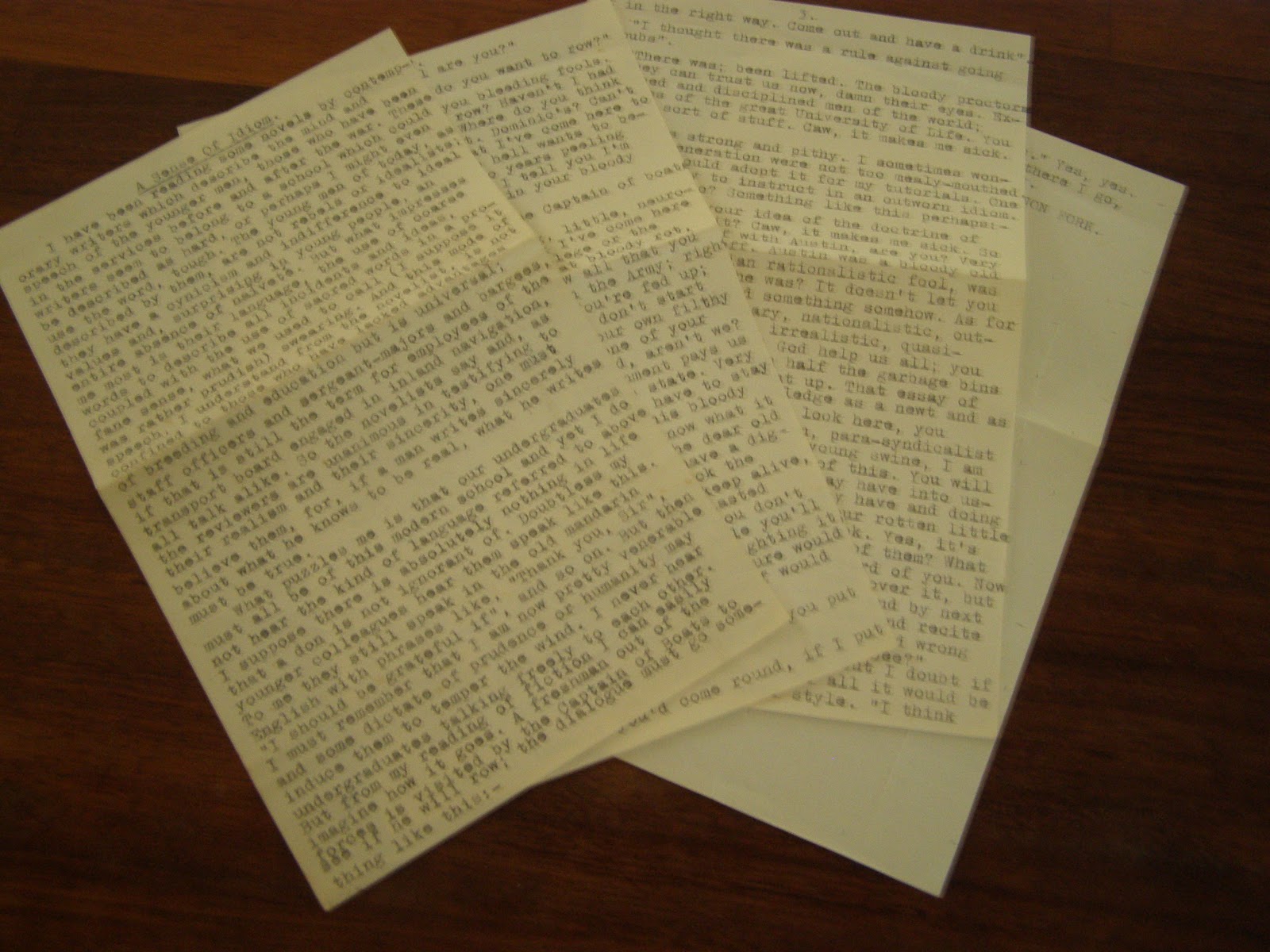
I love when pieces of paper fall out of old books. It feels like you've just won a FREE PRIZE. Here's one of the more interesting pieces I've had fall out. Four small typewritten sheets from an Oxford Don (or pseuDONymous undergraduate?) about the use of idiom in the contemporary novel of the time (late nineteen-forties?). So I guess this is my first guest written (or ghost written) post. If anyone is able to tell me anything about 'Vernon Fork' I would appreciate it. Curiosity may have killed the cat but it wasn't satisfied with that.
A Sense of Idiom
I have been reading some novels by contemporary writers which describe the mind and speech of the younger men, those who have been in the services before and after the war. These writers seem to belong to a school which could be described as hard, or perhaps I might even use the word, tough. The young men of today, as described by them, are not rebels or idealists; they have a cynicism and indifference to ideal values and, surprising in young people, an entire absence of naiveté. But what impresses me most is their language, the use of coarse words to describe all incidents and ideas, coupled with the use of sacred words in a profane sense, what we used to call (I suppose it was rather prudish) swearing. And this mode of speech, I understand from the novelist, is not confined to those who have lacked advantages of breeding and education but is universal; staff officers and sergeant-majors and barges, if that is still the term for employees of the transport board engaged in inland navigation, all talk alike. So the novelists say and, as the reviewers are unanimous in testifying to their realism and their sincerity, one must believe them, for, if a man writes sincerely about what he knows to be real, what he writes must be true.
Tuesday, 3 July 2012
The Shadow of the Wind
The Shadow of the Wind - Carlos Ruiz Zafón
(Translated by Lucia Graves)
Daniel, our hero, is nine. He is taken by his father, an antiquarian bookseller, to a very secret place. He cannot even tell his best friend. "I followed my father through that narrow lane, more of a scar than a street, until the glimmer of the Ramblas faded behind us. The brightness of dawn filtered down from balconies and cornices in streaks of slanting light that dissolved before touching the ground. At last my father stopped in front of a large door of carved wood, blackened by time and humidity. Before us loomed what to my eyes seemed the carcass of a palace, a place of echoes and shadows."
It is as if he is entering a body rather than a place. The place is the Cemetery of Forgotten Books, a labyrinth of books, with 'avenues of exposed spines' and a doorkeeper "somewhere between Charon and the librarian of Alexandria". It is a place where "books no longer remembered by anyone, books that are lost in time, live forever." As this is Daniel's first visit he must adopt one book and do everything to ensure that it is remembered. As he wanders around, "breathing in the small of old paper and dust" he begins to be aware of the treasure within books - "After a while it occurred to me that between the covers of each of these books lay a boundless universe waiting to be discovered, while beyond those walls, in the outside world, people allowed life to pass by in afternoons of football and radio soaps, content to do little more than gaze at their navels."
Labels:
Books,
Books 2012,
Carlos Ruiz Zafon
Sunday, 1 July 2012
Spanish Lit Month - Plans and "Five from the Archive"
Spanish Lit Month
Today is the first day of Spanish Literature Month, hosted by Richard @ Caravana de Recuerdos and Stu @ Winstonsdad's Blog. Auspiciously, they have selected the day when Spain could become the first team to win three major international tournaments in a row. They both have myriad suggestions for reading and there are also "three planned group events scheduled: a discussion of Carlos Saura's 1976 film Cría cuervos this coming weekend, a group read of Juan Carlos Onetti's 1950 La vida breve [A Brief Life] the following weekend, and a group read of Enrique Vila-Matas' 2001 Bartleby y compañía [Bartleby & Co.] the weekend after that."
Labels:
Books,
Books 2012,
Spanish Lit Month
Saturday, 30 June 2012
Cities of the Plain (Second Post)
Cities of the Plain (Sodom and Gomorrah) Second Post
I am building up a backlog of 'draft posts' at the moment and need to clear them away. They sort of nag at me and interfere with my concentration. Do other bloggers have the same issue?
As I mentioned in my first post on Cities of the Plain, I marked enough quotes to produce a novella length post. I'll try to be judicious and excavate a couple of themes that struck me while reading and have stayed with me for the month since.
Labels:
1001 Books,
Books,
Books 2012,
Marcel Proust
Subscribe to:
Posts (Atom)