Sunday, 22 July 2012
Bartleby & Co
Bartleby & Co - Enrique Vila-Matas
On the evidence of this book and Tony's review of Dublinesque
this is another writer to add to the expanding list of writers I need to explore in depth. Bartleby & Co is an essay thinly disguised as a novel, thinly disguised as a series of footnotes to the ongoing death of literature.
Firstly, my disappointment, just to get it out of the way. That is, a disappointment with regards to the book rather than with the inability of man to assign any kind of adhesive meaning to the ongoing story of our species.
When I realized what this book was about - writers who say NO to writing - I felt that I was sure to meet again the great American writer Joseph Mitchell who is mainly known for his last decades when he still continued to come to his office in the New Yorker but published nothing1. However he remains as elusive as his own copy became.
Labels:
1001 Books,
Books,
Books 2012,
Enrique Vila-Matas,
Spanish Lit Month
Friday, 20 July 2012
More Verse
Another installment of my intermittent versification.
Failing
(for L.X. Chilton)
When the targets line up
and I can smell the sweet, cloying, awful smell of success
I look for the trapdoor
Who can bear the weight of approval
It's always a lie
And so would I be
I prefer the weightless
Shape of Failure
Raptors
I listen to two raptors cry
For hours outside
I should be sleeping but it fascinates
More a keening
Than a threat
I feel the frogs shiver
And the voles twitch
Even bats
Stay in their roost
And the raptors cry
For the death they must deliver.
Failing
(for L.X. Chilton)
When the targets line up
and I can smell the sweet, cloying, awful smell of success
I look for the trapdoor
Who can bear the weight of approval
It's always a lie
And so would I be
I prefer the weightless
Shape of Failure
Raptors
I listen to two raptors cry
For hours outside
I should be sleeping but it fascinates
More a keening
Than a threat
I feel the frogs shiver
And the voles twitch
Even bats
Stay in their roost
And the raptors cry
For the death they must deliver.
Labels:
Poetry
Tuesday, 17 July 2012
A Brief Life
A Brief Life - Juan Carlos Onetti
I read this for SpanishLitMonth at Richard's Caravana De Recuerdos and Stu's Winstonsdad's Blog. It was not a book that I had any awareness of previous to it being nominated one of the 'set texts' for SpanishLitMonth. Having fallen behind the target of last weekend I will now play more the part of echo than member of the chorus. And an echo is an apt voice in which to discuss the book full of echoes...
It is an interesting book (interesting is one of those words that sounds faintly damning, isn't it?). At first I found it a little difficult to connect to, feeling at times that sentences remained to be translated from awkwardly constructed English. However this felt less so as the book progressed and I felt more that any obfuscation was deliberate.
There is a dark vision of humanity at play in this book, a disgust which passes itself off as diffidence. The characters, some of whom are nominally real, some of whom are fictional within the fiction, are trapped in an incomplete world, or worlds. Many are impelled to certain acts by a sense of fate, by a sense that they need to arrive at particular points. They are unable to cope with the questions posed by the death latent within them and in all who surround them.
I read this for SpanishLitMonth at Richard's Caravana De Recuerdos and Stu's Winstonsdad's Blog. It was not a book that I had any awareness of previous to it being nominated one of the 'set texts' for SpanishLitMonth. Having fallen behind the target of last weekend I will now play more the part of echo than member of the chorus. And an echo is an apt voice in which to discuss the book full of echoes...
It is an interesting book (interesting is one of those words that sounds faintly damning, isn't it?). At first I found it a little difficult to connect to, feeling at times that sentences remained to be translated from awkwardly constructed English. However this felt less so as the book progressed and I felt more that any obfuscation was deliberate.
There is a dark vision of humanity at play in this book, a disgust which passes itself off as diffidence. The characters, some of whom are nominally real, some of whom are fictional within the fiction, are trapped in an incomplete world, or worlds. Many are impelled to certain acts by a sense of fate, by a sense that they need to arrive at particular points. They are unable to cope with the questions posed by the death latent within them and in all who surround them.
Labels:
Books,
Books 2012,
Juan Carlos Onetti,
Spanish Lit Month
Monday, 9 July 2012
Cría Cuervos
Cría Cuervos - a film by Carlos Saura
This film was selected by Richard @ Caravana de Recuerdos as part of Spanish Literature month so I decided that I would try to get my hands on a copy in time to watch it. However, it was not to be. I found that it was to be released in a few months (it dates from 1976). However, having some time to myself last night I decided I would see if I could view it online and lo and behold, it seemed that I could. And so I settled down to watch.
..CONTAINS SPOILERS.. and much frustration.
Labels:
Carlos Saura,
Film,
Spanish Lit Month
Friday, 6 July 2012
Who was Vernon Fork?
Ghostwritten
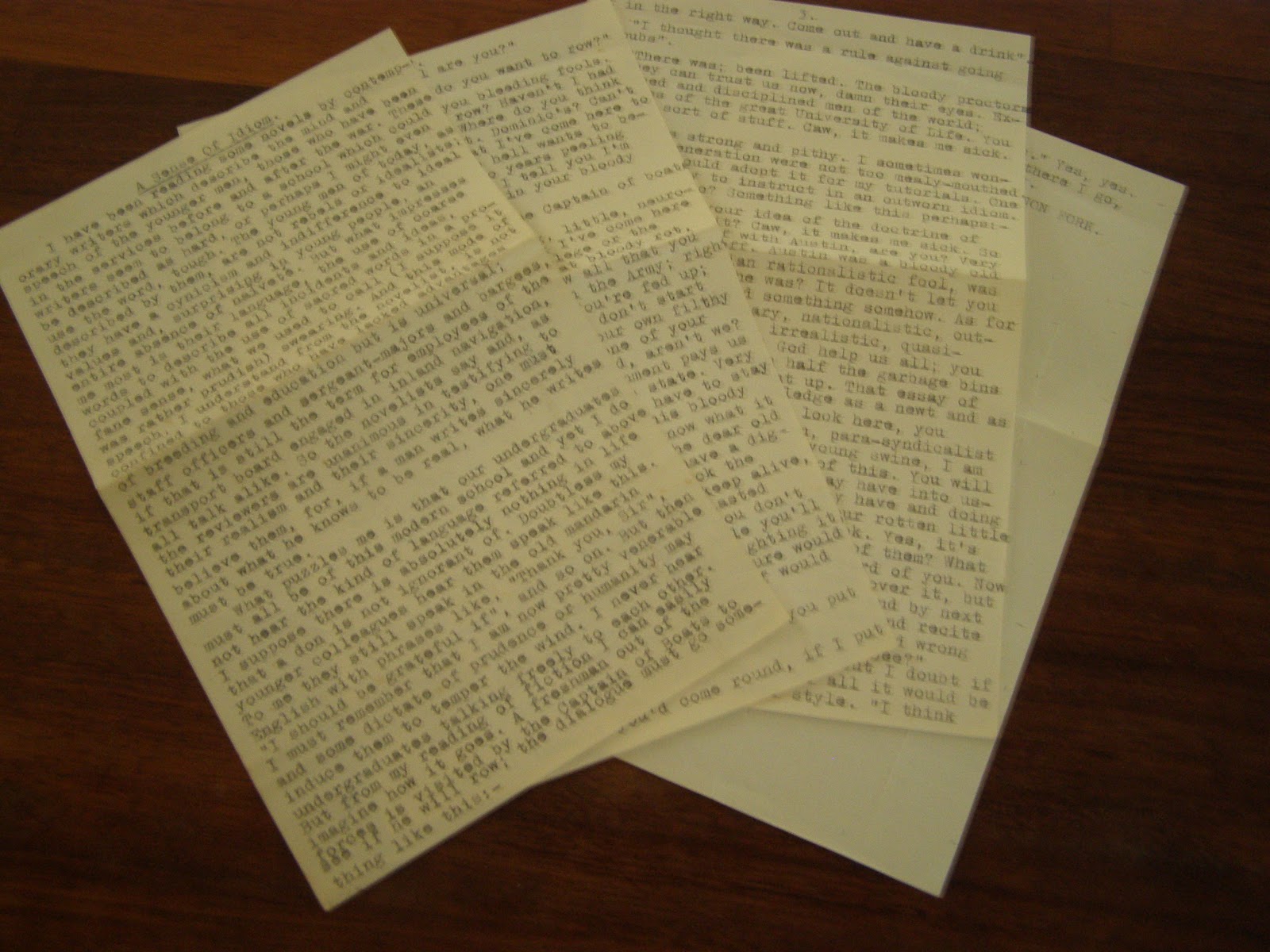
I love when pieces of paper fall out of old books. It feels like you've just won a FREE PRIZE. Here's one of the more interesting pieces I've had fall out. Four small typewritten sheets from an Oxford Don (or pseuDONymous undergraduate?) about the use of idiom in the contemporary novel of the time (late nineteen-forties?). So I guess this is my first guest written (or ghost written) post. If anyone is able to tell me anything about 'Vernon Fork' I would appreciate it. Curiosity may have killed the cat but it wasn't satisfied with that.
A Sense of Idiom
I have been reading some novels by contemporary writers which describe the mind and speech of the younger men, those who have been in the services before and after the war. These writers seem to belong to a school which could be described as hard, or perhaps I might even use the word, tough. The young men of today, as described by them, are not rebels or idealists; they have a cynicism and indifference to ideal values and, surprising in young people, an entire absence of naiveté. But what impresses me most is their language, the use of coarse words to describe all incidents and ideas, coupled with the use of sacred words in a profane sense, what we used to call (I suppose it was rather prudish) swearing. And this mode of speech, I understand from the novelist, is not confined to those who have lacked advantages of breeding and education but is universal; staff officers and sergeant-majors and barges, if that is still the term for employees of the transport board engaged in inland navigation, all talk alike. So the novelists say and, as the reviewers are unanimous in testifying to their realism and their sincerity, one must believe them, for, if a man writes sincerely about what he knows to be real, what he writes must be true.
Tuesday, 3 July 2012
The Shadow of the Wind
The Shadow of the Wind - Carlos Ruiz Zafón
(Translated by Lucia Graves)
Daniel, our hero, is nine. He is taken by his father, an antiquarian bookseller, to a very secret place. He cannot even tell his best friend. "I followed my father through that narrow lane, more of a scar than a street, until the glimmer of the Ramblas faded behind us. The brightness of dawn filtered down from balconies and cornices in streaks of slanting light that dissolved before touching the ground. At last my father stopped in front of a large door of carved wood, blackened by time and humidity. Before us loomed what to my eyes seemed the carcass of a palace, a place of echoes and shadows."
It is as if he is entering a body rather than a place. The place is the Cemetery of Forgotten Books, a labyrinth of books, with 'avenues of exposed spines' and a doorkeeper "somewhere between Charon and the librarian of Alexandria". It is a place where "books no longer remembered by anyone, books that are lost in time, live forever." As this is Daniel's first visit he must adopt one book and do everything to ensure that it is remembered. As he wanders around, "breathing in the small of old paper and dust" he begins to be aware of the treasure within books - "After a while it occurred to me that between the covers of each of these books lay a boundless universe waiting to be discovered, while beyond those walls, in the outside world, people allowed life to pass by in afternoons of football and radio soaps, content to do little more than gaze at their navels."
Labels:
Books,
Books 2012,
Carlos Ruiz Zafon
Sunday, 1 July 2012
Spanish Lit Month - Plans and "Five from the Archive"
Spanish Lit Month
Today is the first day of Spanish Literature Month, hosted by Richard @ Caravana de Recuerdos and Stu @ Winstonsdad's Blog. Auspiciously, they have selected the day when Spain could become the first team to win three major international tournaments in a row. They both have myriad suggestions for reading and there are also "three planned group events scheduled: a discussion of Carlos Saura's 1976 film Cría cuervos this coming weekend, a group read of Juan Carlos Onetti's 1950 La vida breve [A Brief Life] the following weekend, and a group read of Enrique Vila-Matas' 2001 Bartleby y compañía [Bartleby & Co.] the weekend after that."
Labels:
Books,
Books 2012,
Spanish Lit Month
Saturday, 30 June 2012
Cities of the Plain (Second Post)
Cities of the Plain (Sodom and Gomorrah) Second Post
I am building up a backlog of 'draft posts' at the moment and need to clear them away. They sort of nag at me and interfere with my concentration. Do other bloggers have the same issue?
As I mentioned in my first post on Cities of the Plain, I marked enough quotes to produce a novella length post. I'll try to be judicious and excavate a couple of themes that struck me while reading and have stayed with me for the month since.
Labels:
1001 Books,
Books,
Books 2012,
Marcel Proust
Friday, 22 June 2012
Harriet Said
Harriet Said - Beryl Bainbridge
This is my contribution to Beryl Bainbridge Reading Week which is being hosted at Gaskella. There are already (at least) two reviews of Harriet Said posted here and here. I look forward to reading them after posting my own thoughts here.
As mentioned in an earlier post this book was initially turned down for publication in the late fifties and was eventually published a decade later after Bainbridge had published two other books. It is a loose riff on the murder case that formed the basis for Peter Jackson's film Heavenly Creatures.
This reminded me in many ways of In Cold Blood. It is clear that Bainbridge was imaginatively fascinated with the girls in the murder case and there is almost sense of glee at the way they defied perceived wisdom and a fascination with their motivations. How could two young girls commit such a horrible crime? It's not a 'sugar and spice' act. More "slugs and snails" methinks. The two girls are Harriet (13) and the unnamed narrator (14). Their main dance partner (for the whole book seems like a dance) is Peter Biggs a.k.a. The Tsar, a tired, unhappily married middle aged man.
Labels:
Beryl Bainbridge,
Books,
Books 2012
Tuesday, 19 June 2012
I'm Not Scared
I'm Not Scared - Niccolò Ammaniti
Right from the start of this book we are immersed in the world of children, a world of innocence, cruelty, fear and half understood elements of the adult world around them. The world is partly the world of fable, in as much as witches and monsters form part of the child narrator's understanding of the world. I will try to keep the plot out of this post as it is driven by a simple yet involving plot which I don't want to spoil for anyone.
This is in part a horror story, in part a rite of passage story showing how a child's understanding of the world grow and the horizons of his vision expand. The way something can suddenly APPEAR in the world of a child, despite having been there all along, is beautifully illustrated early on when the children go to explore the farm on which some legendarily vicious pigs live. They intend throwing a hen in to the pigs to "see how they tear it apart."
"'But papa will kill me if we take one of his hens,' Remo wailed.
It was no use, the idea was a really good one." Ideas, if powerful enough, give birth to their actuality.
Labels:
1001 Books,
Books,
Books 2012,
Brendan Muldowney,
Niccolò Ammaniti
Friday, 15 June 2012
Punk Britannia, Episode II
Before episode three of BBC's documentary series celebrating the 35th 'Jubilee' of punk I thought I'd try to stitch together some fragments I jotted down into something resembling a blog post. I have already posted on episode one here.
For your listening pleasure (and some pain!) I have put together a playlist of the songs used in this episode.
Labels:
Documentary,
Irish in England,
Music,
Punk
Monday, 11 June 2012
Carpenter's Gothic
| My battered and much read copy of Carpenter's Gothic |
"I cannot really work unless I set a problem for myself to solve. In Carpenter’s Gothic the problems were largely of style and technique and form. I wanted to write a shorter book, one that observes the unities of time and place to the point that everything, even though it expands into the world, takes place in one house, and a country house at that, with a small number of characters, in a short span of time. It became really largely an exercise in style and technique. And also, I wanted to take all these clichés of fiction to bring them to life and make them work. So we have the older man and the younger woman, the marriage breaking up, the obligatory adultery, the locked room, the mysterious stranger, and so forth." William Gaddis, The Paris Review
Whenever I return to a favorite book, or writer, after a gap of some years there is an element of fear. I'm afraid that what I once saw will have disappeared or no longer mean as much. I suppose I distrust my younger self or feel that I may no longer be prepared to work as hard at a book as he was.
But I need not have had any worries here. If anything, Carpenter's Gothic improves with age. From a dingy house on the banks of the Hudson we hear reports, half truths and rumours from across America and Africa. Greed, money, religion, politics, all human life is here in a more concentrated form than the two large novels that preceded it. The main action takes place out of our vision and the main carriers of the news are totally unreliable, but from these scraps we can build our own edifice.
Labels:
Books,
Books 2012,
William Gaddis
Tuesday, 5 June 2012
Punk Britannia - Pre Punk 1972-1976
Some loose thoughts and Youtube surfing inspired by watching the first episode of BBC4's Punk Britannia. This is more a string of impressions and opinions than a review.
(Q!uotes are approXXXimate, OPinions are my own!! even if they are others also!!! RIGHT!!!!)
"People would ask me what does it mean? is it a love song? The best answer I have is that New Rose is about the punk scene.." - Brian James, The Damned
Some loose thoughts and Youtube surfing inspired by watching the first episode of BBC4's Punk Britannia. This is more a string of impressions and opinions than a review.
(Q!uotes are approXXXimate, OPinions are my own!! even if they are others also!!! RIGHT!!!!)
"People would ask me what does it mean? is it a love song? The best answer I have is that New Rose is about the punk scene.." - Brian James, The Damned
Labels:
Documentary,
Film,
Music,
Punk
Saturday, 2 June 2012
Cities of the Plain (Sodom and Gomorrah) First Post
Cities of the Plain (Sodom and Gomorrah)
I expected to be well finished my journey with Proust by this time but the year is proving a slow reading one. Some of this may be down to the fact that Proust demands to be read slowly, with great attention, but it is more that I am finding it difficult to find TIME to read. And then even more difficult to find time to blog.
Labels:
1001 Books,
Books,
Books 2012,
Marcel Proust
Wednesday, 23 May 2012
The Conformist
The Conformist - Bernardo Bertolucci (1970)
I'm currently falling further and further behind on my reading targets for the year so thought I would at least make an attempt to hit my target of reviewing a decent amount (six or seven) films for the Foreign Film Festival at Richard's Caravana de Recuerdos and simultaneously, for Caroline's World Cinema Series at her blog Beauty is a Sleeping Cat. Two birds with one stone, I like it.
Once again ignoring the piles of unwatched DVD's scattered around the house I made use of my Netflix account and so watched Bertolucci's The Conformist on my laptop, probably not optimum conditions to watch one of cinemas acknowledged visual classics. I was also tired so had to rewind on a couple of occasions when my attention headed for my own dream landscape, and away from Bertolucci's.
Labels:
Bernardo Bertolucci,
Film
Thursday, 17 May 2012
National Flash Fiction Day
The internet tells me it was National Flash Fiction Day yesterday, in the UK. Well, it's flash fiction day here on Vapour Trails today.
Moses McGrath
When the card was declined my left eye started to twitch. I knew instinctively that the others would not have the money. That meant we were going to have to make a deal with the Egyptians.
When the manager came out to see me he looked stressed, and damp.
"How is this, you cannot pay for what you have eaten?"
"Maybe, do you have a leak?"
"Yes, leak and much water! And where to get a plumber at night?"
"Right here"
Thirty minutes later, the floor of the kitchen was being mopped dry and I emerged to lead my people home.
"Free food, manna from heaven in these belt tightening days."
(It was written in a flash, Gordon, so go easy on me.)
The internet tells me it was National Flash Fiction Day yesterday, in the UK. Well, it's flash fiction day here on Vapour Trails today.
![]() |
| Moses ache |
When the card was declined my left eye started to twitch. I knew instinctively that the others would not have the money. That meant we were going to have to make a deal with the Egyptians.
When the manager came out to see me he looked stressed, and damp.
"How is this, you cannot pay for what you have eaten?"
"Maybe, do you have a leak?"
"Yes, leak and much water! And where to get a plumber at night?"
"Right here"
Thirty minutes later, the floor of the kitchen was being mopped dry and I emerged to lead my people home.
"Free food, manna from heaven in these belt tightening days."
(It was written in a flash, Gordon, so go easy on me.)
Labels:
Flash fiction
Saturday, 12 May 2012
Beryl Bainbridge Reading Week
There is a Beryl Bainbridge Reading Week coming up next month, hosted by Annabel at Gaskella. I am looking forward to reading at least a couple more of Bainbridge's novels. Wittily transgressive, I have enjoyed all of her work that I have read thus far: Winter Garden; The Bottle Factory Outing and Master Georgie.
I would particularly recommend the second two, both of which have featured on this blog, although The Bottle Factory Outing gets but a few lines. Master Georgie featured on my "Best of" from last year.
Labels:
Beryl Bainbridge,
Books,
Books 2012
Wednesday, 9 May 2012
In Cold Blood
In Cold Blood - Truman CapoteThis is a great book: fascinating for the details of the horrific crimes and even more fascinating for Capote's fascination with the crimes. And then there is the writing: precise, potent and poetic.
From the start Capote creates an air of inevitability. Assuming some knowledge of the crime at the heart of the book he uses this knowledge and amplifies it to give the reader a sense of impending horror. A sketch of the town of Holcomb is followed by this paragraph - "Until one morning in mid-November of 1959, few Americans - in fact, few Kansans - had ever heard of Holcomb. Like the waters of the river, like the motorists on the highway, and like the yellow trains streaking down the Santa Fe tracks, drama, in the shape of exceptional happenings, had never stopped there." Like the whistle of a train rushing past a platform this shatters the peaceful stillness of the small-town still life we have been first presented with. That's if the title of the book and of the first section: "The Last to See Them Alive" hadn't made that peace a foggy illusion even before the start. (At this stage I'll warn those who want to know no more not to continue. I don't think many can have avoided the knowledge that they will pick up in the rest of this post but if you know little and want to read the book first, do so, then come back here and disagree with me.)
Labels:
Books,
Books 2012,
Truman Capote
Saturday, 5 May 2012
Very Extremely Dangeous
Very Extremely Dangerous - une film de Paul Duane
The trailer for Paul (Barbaric Genius) Duane's new documentary on the very extremely dangerous Jerry McGill. It is currently doing the round of film festivals. Watch the trailer right to the end, where we here Paul's laconic cool shatter as he sees his final end and cries out like a Yankee - "Jesus Christ, Jerry!"
Looking forward to seeing the whole film.
The trailer for Paul (Barbaric Genius) Duane's new documentary on the very extremely dangerous Jerry McGill. It is currently doing the round of film festivals. Watch the trailer right to the end, where we here Paul's laconic cool shatter as he sees his final end and cries out like a Yankee - "Jesus Christ, Jerry!"
Looking forward to seeing the whole film.
Labels:
Film,
Paul Duane
Friday, 4 May 2012
We, the Drowned
We, the Drowned - Carsten Jensen
or...One Hundred Years of Sailortude - In which Scandanavian fiction takes sail on a fair wind from South America.
This is a strange and ambitious book - mixing history: economical, political, social and technological; with fabulous adventures on the high seas and moments of high comedy. My sense is that it would have more meaning for someone with a greater knowledge of Danish history (during two summers working in Copenhagen all I learnt was to understand people ordering pizzas in Dansk). It is a history of the town of Marstal and a number of it's inhabitants, a town dominated by the neighbouring sea, a town often left to women, children and old men as the men took to the high seas, often to be gone for years.
Labels:
Books,
Books 2012,
Carsten Jensen
Subscribe to:
Posts (Atom)