Here's some great music from an ex-member of The Knocking Shop and some friends.
Enjoy!

Thursday, 17 November 2011


Tuesday, 15 November 2011
By Night in Chile
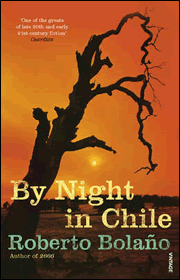
By Night in Chile - Roberto Bolaño
The titular night is the night during which the priest Father Sebastian Urrutia narrates his feverish memoirs; it is also the darkness that passed over Chile under Pinochet; it also refers to the nightime activities of the Chilean literati and other dark times.
Right from the start Fr Urrutia introduces one of the novels main themes. Urrita immediately follows his declaration of Chilean nationality by letting us know that "My ancestors on my fathers side came from the Basque country, or Euskadi, as it is now called. On my mother's side I hail from the gentle land of France." Throughout the book, he will refer to people of native Chilean descent as 'ugly', while he himself is "noble" looking, a hint that he may not be much of a Chilean.
Wednesday, 9 November 2011
All Souls

All Souls - Javier Marías
This is my second book by Marías in the past few months and I will be looking out for more. Different but sharing an interest in translation with my first taste of his writing Bad Nature , this is a variant on the English university novel. Given its name it seemed like an appropriate read for the Halloween season but has more humour than horror, although horror is not absent.
The main theme of the book is time and the duality of experience. This duality meshes nicely with Marias' interest in translation. We have rivers with more than one name interwoven through the book, physically representing the movement of time and also the subjective nature of naming. The fact that Oxford is a hotbed of agents (and double, and even triple agents) is also mentioned. Everyone is seen to be playing games of deception and those who aren't are seen as suspect.
Sunday, 6 November 2011
Bad Vibes

Bad Vibes - Luke Haines
In which Luke Haines turns his life into Auteurian legend with himself cast as a misantrophic Merlin calling down destruction on the party. The acid tongued songwriter was always at the literate end of the music industry (not that that says much) and he carries off this bookwriting thing with some aplomb.
It helps, of course, that I share my year of birth with Mr Haines and so the cultural references are very familiar and the objects of his withering fury are ones I would largely share. (Also he praises Johnathan Richman, Go-Betweens, Momus and Vic Godard among others so is clearly therefore a man of exquisite taste.)
Tuesday, 1 November 2011
Neuromancer

Neuromancer - William Gibson
This book is credited with the birth of the cyberpunk genre and certainly it now seems very familiar from its many progeny. I never got around to reading this in the eighties so I cannot comment on whether or not I would have felt the shock of the new had I read it then.
The world in which it takes place is largely that of Burroughs meets Blade Runner but with added virtuality. In the afterword to my edition, Gibson credits reading Alfred Bester's The Stars My Destination, Burroughs' Interzone and hearing The Velvet Underground's 'Banana' album with the inspiration for Neuromancer.
Saturday, 29 October 2011
Nazi Literature in the Americas

Nazi Literature in the Americas - Roberto Bolano
An imaginary encyclopedia of literary losers who tend to fly in circles as they have only got right wings Nazi Literature in the Americas is both a humorous parlour game and a howl of disgust. Lying at its heart are the fascist regimes and disappearances that blighted South America over the course of Bolano's life. There is also a sense, which grows in it's absence, of the importance of literature, that evil needs it's apologists in order to flourish.
Although some of the entries in this sourcebook relate to each other, it is largely without plot and most entries are discrete. However, like in Nabokov's Pale Fire, we are invited to read between the lines to create the world that contains these people. There is no narrative line to follow through the book but the delight in the ever expanding detail of this parallel world. Were they to have existed, or exist now, many of these writers would not even have achieved obscurity.
Just Kids

Just Kids - Patti Smith
"I didn't mind the misery of a vocation but I dreaded not being called."
Patti Smith knew early on that she wanted to be an artist. This is the story of how she discovered her vocation and her fellow traveller on that early journey, the photographer Robert Mapplethorpe, whom she met soon after arriving in New York. "I was superstitious. Today was a Monday; I was born on a Monday. It was a good day to arrive in New York City. No one expected me. Everything awaited me."
The book uses Smith's diaries and has a very immediate feel. You can sense her finding her feet in the city, and confidence in her various artistic enterprises: painter, poet, muse...
Sunday, 23 October 2011
Amulet

Amulet - Roberto Bolano
There is something rhapsodic about Bolano's writing, making what is static and ephemeral in the plot seem propulsive and concrete. The action is in the metaphor, in the vigour of the writing.
Amulet revisits the terrain of The Savage Detectives. It is, in fact, a reworking of part of the longer work with the emphasis changed. Auxilio Lacouture, an Uruguyan living in Mexico city recounts events from her bohemian life among poets and academics, including the lightly disguised "Arturo Belano".
From the very start we are told that this book is a "horror story. A story of murder, deception and horror. But it won't appear to be, for the simple reason that I am the teller. Told by me, it won't seem like that. Although, in fact, it's the story of a terrible crime."
Friday, 21 October 2011
The Elephant's Journey

The Elephant's Journey - Jose Saramago
This is a journey sustained on a humourous tension between telling the tale and dismantling it. Before we even start on the story proper, Saramago tells of it's genesis in the mural on the wall of a restaurant. So we know the book is the result of "a chance encounter", almost a whim.
This provisionality is a key element of The Elephant's Journey, not just the writing but the story itself. The story involves the sending of Solomon the elephant from the King and Queen of Portugal in Lisbon to the Archduke Maxmillian of Austria (the Queen's cousin) who is in Valladolid and will then take Solomon on the Vienna. The idea of sending this late wedding gift is a whim, which the Queen almost regrets (but not quite). Solomon had been a great success on his arrival in Lisbon but now he is yesterdays news and languishes in filthy obscurity with his Indian mahout, Subhro (white). This is projected to be his future in Vienna, too: "there'll be a lot of applause, a lot of people crowding the streets, and then they'll forget all about him, that's the law of life, triumph and oblivion."
Sunday, 16 October 2011
Shuttlecock

Shuttlecock - Graham Swift
Prentis is a minor civil servant in an office where dead cases are archived. He envies his boss his power and his father his status as a wartime hero. His wife and two children suffer the brunt of his dissatisfaction as he exercises his power over them, even when he knows that what he is doing is wrong.
This he writes down in a form of confessional, which begins with a memory he has of a pet hamster from his youth. "You see, I used to torment my hamster. I was cruel to Sammy. It wasn't a case of wanting to play with him, or train him, or study how he behaved. I tortured him." He is trying to understand himself. Why was it that while he tortured Sammy he was a good son to his parents but before Sammy arrived on the scene and after he died he was difficult. Why?
Saturday, 15 October 2011
Child of God

Child of God - Cormac McCarthy
"he turned and shook the rifle alternately at the flooded creek and at the gray sky out of which the rain still fell grayly and without relent and the curses that hailed up above the thunder of the water carried to the mountain and back like echoes from the clefts of bedlam."
At once futuristic and ancient, Child of God presents a story of disquieting horror dwarfed in a frame of wild nature and timelessness. Centre stage is Hank Ballard, a tin man whose clockwork is damaged yet inexorably drives him on. He is empty, unreflective as water in a pitch black cavern, and like that water he flows ever downwards. He is evicted and the first scene is a carnivaleque auction of his house and land, where while attempting to halt the sale he winds up knocked unconscious by an axe.
Tuesday, 11 October 2011
The Blackwater Lightship

The Blackwater Lightship - Colm Tóbín
This is a tender and careful book, probing gently into the shells wherein three generations of a family have housed their buried pains and unresolved emotions.
The catalyst for this exploration is the news that Declan, brother of Helen and child of Lily wants to go to his granny Dora's house to get away from the hospital for a while. He is dying of AIDS but hasn't told his family and has relied on his good friends Paul and Larry, who have nursed him through his illness until now.
As well as the immanent loss of Declan, the book focusses on earlier losses, particularly the early death of Helen and Declan's father, Lily's husband. The repercussions of this are still twisting their lives into uncomfortable shapes. On the surface Lily and Helen are successful professionals but emotionally, they are fractured and brittle. "When my father died, half my world collapsed, but I did not know this had happened. It was as though half my face had been blown away and I kept talking and smiling, thinking that it had not happened, or that it would grow back." Things have been so bad between them that Lily was not asked to her daughter's wedding nor has she met her son in law nor grandchildren.
Thursday, 6 October 2011
Another World

Another World - Pat Barker
This book would make a great Graphic Novel. It is full of arresting and immediate images that are central to the plot and repeated visual motifs. It is the story of a family; psychology professor Nick and his daughter Miranda, Nick's partner Fran and her son Gareth, Nick and Fran's "shared children": Jasper and his unborn sibling; and Nick's Grandfather Geordie.
The books masterfully builds a feeling of awful anticipation and a vertiginous sense of the anxieties of modern life: "like everyone else he lives in the shadows of monstrosities. Peter Sutcliffe's bearded face, the number plate of a house in Cromwell Street, three figures smudged on a video surveillance screen, an older boy taking a toddler by the hand while his companion strides ahead, eager for the atrocity to come."
Tuesday, 4 October 2011
Exiles on Asperus

Exiles on Asperus - John Wyndham
Aahh, some good old fashioned Boy's Own tales; ray guns and alien races; life on Mars and Venus and elsewhere; the future foretold. This is a collection of three stories from Day of the Triffids author John Wyndham. Two, Exiles on Asperus and The Venus Adventure, from the early thirties and the other, No Place Like Earth, from 1951.
The stories all look askance at the human race, using the horrors perpetrated in the name of colonialism as a model for how we will behave in space. The alien races are all far more moral than they are depicted. In Exiles on Asperus, Sen-Su, leader of the Martian revolution says: "They have made quite a bogy of me on Earth; I assure you they exaggerate. It has been Governmental policy to malign me - Governments have to create thorough-going villains. In private life we should call them liars, but in public life they are propagandists."
Ghost Light

Ghost Light - Joseph O'Connor
"Ghost light. An ancient superstition among people of the stage. One lamp must always be left burning when the theatre is dark, so the ghosts can perform their own plays."
Molly Allgood was engaged to John Millington Synge when he died. She was an actress in the Abbey and was the first actress to play the iconic role of Pegeen Mike in Synge's masterpiece The Playboy of the Western World, playing to an angry rioting crowd incensed by this portrayal of themselves. We begin this book with Molly living in a "hungry room", her neighbours largely Irish navvies, her company largely poured from bottles and "the scuttle of the past out of cupboards.". It is almost a return to her girlhood over a junkshop in Mary Street in the infamous tenements of Dublin.
Molly's final residence is like Yeat's "foul rag and bone shop of the heart" and she swims among her memories, which are dominated by her years with Synge. Synge was a Protestant from a landowning family and almost twenty years older than Molly. The gulf between them was large and their relationship (in this novel) was not looked kindly upon by Synge's partners in the Abbey, Yeats and Lady Gregory, nor Synge's widowed mother. O'Connor imagines them meeting on the train to Bray, not acknowledging each other until they thought themselves safe from being seen by those who knew them, to avoid scandal.
Friday, 30 September 2011
The Double

The Double - Jose Saramago
"an algebraic equation with people's faces where there should have been letters."
This is a book soaked in Mathematics. Indeed it reminded me forcefully of an occasion in my schooldays when I was asked to come to the blackboard and write out the proof of a theorem we were supposed to have learnt. The theorem was nice and concise but I hadn't learnt it. I may not even have looked at it and I had far more entertaining things to listen to in the classroom than the teacher. So I had to start from scratch and I filled the blackboard twice, following a number of hunches that brought me nowhere, before finally arriving at the proof. This was, of course, very amusing to the teacher.
Staying with half digested maths, it is my understanding that one of the many ideas in quantum mechanics is that anything that can happen, will happen. In this case the plot of The Double is not that farfetched. Tertuliano Máximo Afonso, a history teacher who is suffering from mild depression is advised to watch a certain film by "his colleague, the Mathematics teacher." He watches the video and finds it unremarkable and as cliched as its title "The Race is to the Swift."
Monday, 26 September 2011
The Centauri Device

The Centauri Device - M John Harrison
This is a strange and interesting novel. Written in a style which seems to try to meld Chandler and Burroughs it has a dreamlike ambiance while telling a straightforward enough Pirate tale full of ships, bo'suns and ports; albeit in space, and on the 400th anniversary of the Summer of Love.
John Truck is the son of the last pureblooded Centaurian, and as such he is the only one who can operate the Centauri device of the title. This device has been discovered by Grishkin, the leader of the major religion of the time, the Openers, who have windows in their bodies to reveal their innards. The device is also wanted by the Israeli's (IWG) and the Arabs (UASR), the conflict between whom has led to what's left of Earth being split between them, their conflict continuing amoung the stars.
Thursday, 22 September 2011
The Siege of Krishnapur

The Siege of Krishnapur - J.G.Farrell
I haven't laughed out loud at a book so much for quite a while. What began as a series of low civilised chuckles to myself ended up with quite a few loud guffaws and extended periods where laughter bubbled up from my stomach like carbon dioxide through soda water. I then had to sheepishly mumble to my partner that I was laughing at some particularly gory scenes of dismemberment.
The novel tells the story of an uprising in an isolated province in India which leads to an extended siege of the residence of the Collector, the chief bureaucrat in the province.
I feel obliged at this point to say that this review contains some spoilers although I feel that they will not in any way spoil the enjoyment to be derived from the book.
Wednesday, 14 September 2011
"Poetry?"
Pomes
I have been contributing the odd poem to one of my online reading groups this year and thought I'd gather some together here to give everyone who reads this a chance to point and laugh.
I have been contributing the odd poem to one of my online reading groups this year and thought I'd gather some together here to give everyone who reads this a chance to point and laugh.
Knees
I unwound the bandages
and flinched
You were unwinding
Like a spring
gone loose
and flinched
You were unwinding
Like a spring
gone loose
The years wind around me
Like a torn cloth
Like a torn cloth
Tuesday, 13 September 2011
The Eye

The Eye - Vladimir Nabokov
"A thing I had long suspected - the world's absurdity - became obvious to me."
The Eye is an early (1930) novel from Nabokov which he translated from the original Russian in the mid sixties. In his foreword he talks of the difficulties faced in translating the title.
"The Russian title of this book is SOGLYADATAY (in traditional transliteration), pronounced 'Sugly-dart-eye', with the accent on the penultimate. It is an ancient military term meaning 'spy' or 'watcher', neither of which extends as flexibly as the Russian word. After toying with 'emissary' or 'gladiator', I gave up trying to blend sound and sense, and contented myself with matching the 'eye' on the end of the long stalk."
The book is set in Berlin in 1924-25 amoung the Russian emigre community but Nabokov doesn't try to make any political point - saying - "they might just as well have been Norwegians in Naples or Ambracians in Ambridge." The nature of emigrant communities, where disparate people are thrown together by the simple fact of their nationality is evident in the book, however.
Subscribe to:
Posts (Atom)